


Student-athletes need financial help with NIL deals because the income arrives before anyone has taught them how money works. A deal creates taxes, a contract, and a spending decision in the same week. Most athletes meet all three alone. So the fix sits with the athletic department, and it starts with a live session that lets them practice before the money is real.
I’m not a financial advisor. I’m a coach. I’ve spent nine seasons teaching rookies inside NFL and NBA organizations, and I work with athletic departments at LSU, Texas A&M, Boise State, and Oregon State. Here’s what I tell every director of student-athlete development. Your athletes will make the same money mistakes pro rookies make, only earlier and with less help. So this post walks through what goes wrong before, during, and after a deal. Then it covers what your department can put on the calendar this season.

Why do student-athletes need financial help with NIL deals at all?
They need it because they’re college students first, and most college students are already short on money and instruction. The Trellis Strategies Student Financial Wellness Survey heard from more than 65,000 undergraduates in fall 2025. It found 65 percent had run out of money at least once since the start of the year. It also found 54 percent would struggle to get $500 in cash or credit for an unexpected expense. That’s the starting line for the athlete who just signed a brand deal which is why student athletes need financial help with NIL deals
Then add the sport. A 2025 study in the Journal of College Student Development found student-athletes show lower financial literacy than non-athletes, even after controlling for background and school. That makes sense to me, because their calendar leaves no room for a money class.
Meanwhile, the money is already moving. The same Trellis survey found 69 percent of students had faced financial challenges while in college, and 88 percent of those with a credit card used it for basic needs like food, transportation, and housing. So the athlete signing their first NIL deal isn’t starting from zero. They’re often starting from behind, and Financial Help With NIL deals puts income on top of that gap.
[INFOGRAPHIC 1: The starting line. Prompt in the visual spec.]
What goes wrong before an athlete signs?
Before signing, the mistake is saying yes without a baseline or a team. An athlete gets an offer, feels the clock, and signs what’s in front of them. Nobody asked what they spend in a month. Nobody read the contract with them.
So I teach two things first. The first is to assess your baseline, which means knowing what comes in and what goes out before a deal changes either number. The second is the financial team. I believe a CPA is the first hire, ahead of anyone who wants to invest the money. A CPA looks at the whole picture, and the tax bill is the first problem an NIL earner will meet.
I also teach the difference between trust and friendship. A lot of people show up when an athlete starts earning, and some of them are friends. But being a friend and being someone you can do business with are different tests. Athletes need to hear that from somebody who isn’t taking a cut.
What goes wrong when the NIL money arrives?
When the money arrives, the mistake is treating the full deposit as spendable. NIL pay usually comes with nothing withheld, so the tax bill shows up months later. The IRS guidance on name, image, and likeness income is plain about it. All NIL income is generally taxable, and that includes non-cash compensation like merchandise, gift cards, and free services. Income earned for services is also generally subject to Social Security and Medicare taxes. Because of that, an athlete may need to make estimated tax payments during the year.
There’s a newer wrinkle too. For payments received in 2026, the IRS reporting threshold for Form 1099-NEC is $2,000. So an athlete can earn taxable NIL income and never receive a form for it. The income still counts. The IRS also tells athletes to track where they perform the work, because they may owe tax to another state.
In the room, this becomes a drill. I put real scenarios on the screen and ask one question: W2 or 1099? Athletes call it out. Then we talk about what each answer means for the money they keep. I tell them taxes are your rent for living in the United States. You set the rent aside first, and you spend what’s left.
What goes wrong after the deal ends?
After the deal, the mistake is building a lifestyle on income that was never permanent. NIL money is variable. A deal can end with an injury, a transfer, or a quiet season. However, the car payment and the apartment don’t end with it.
That’s why I teach burn rate. Take your expenses and divide them by your income. If the lifestyle and the income don’t match, the math will never math. I’ve watched pro players go broke because they wouldn’t admit the lifestyle no longer matched the income. College athletes can learn that lesson at 19, with smaller numbers, in a room where it’s safe to get it wrong. To me, that’s the part of financial help with NIL deals that lasts longest.
Credit belongs here too, because a first deal is often when the first card shows up. I teach three rules of credit: pay on time, use it correctly, and be consistent. Then I ask for a volunteer’s credit limit and we multiply it by 0.3 together. That’s the number to stay under each month. Every athlete in the room runs it on their own card before we move on.
[INFOGRAPHIC 2: Before, during, after. Prompt in the visual spec.]
What can your athletic department put in place this season?
Your department can put one money session at each stage of the athletic calendar, and none of it has to land on your compliance staff. The programs I build for universities and NIL are planned by sport and by season, so they fit the roster and the travel weeks. Here’s a calendar that works.
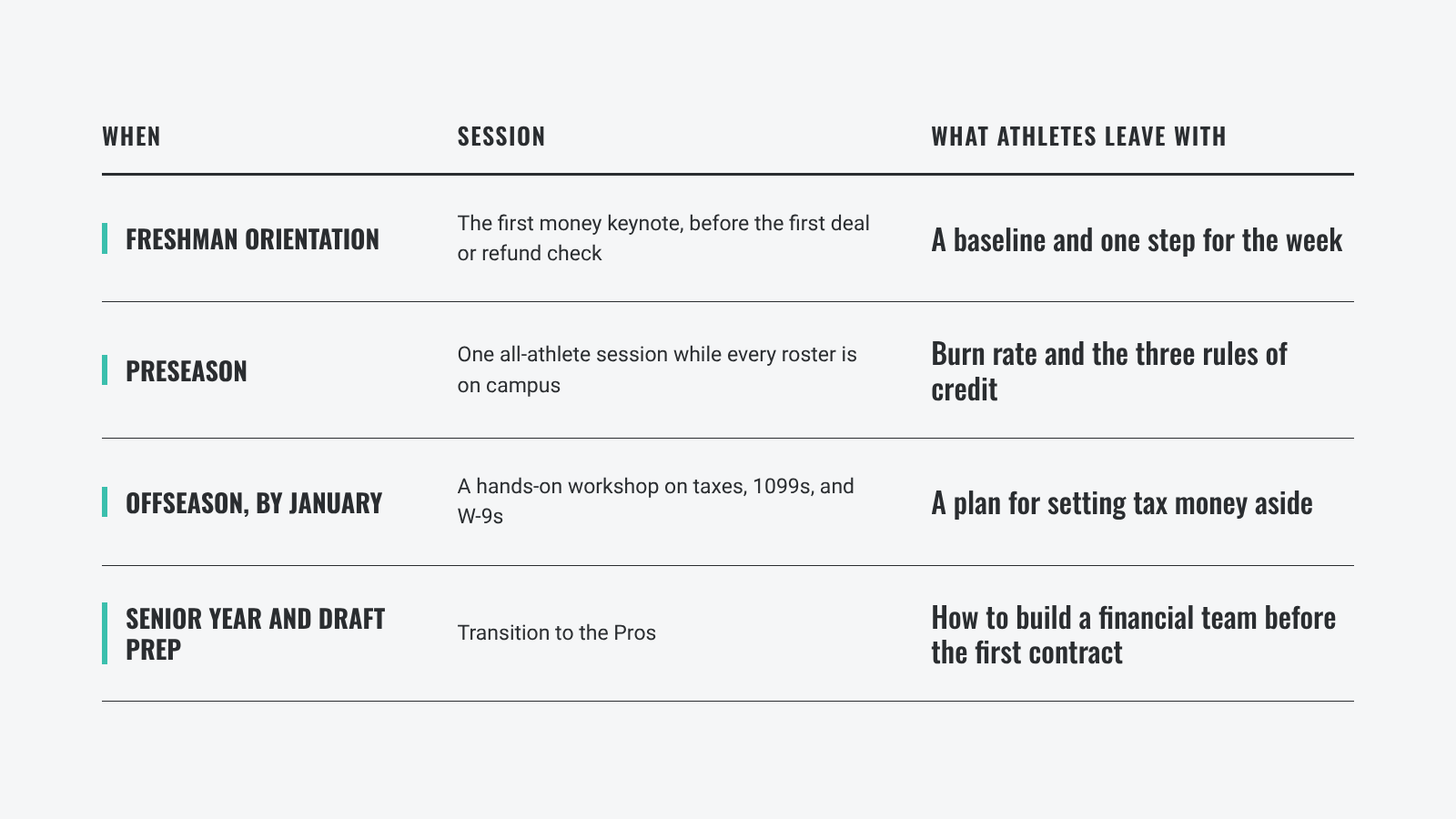
The offseason piece does the most work. It’s one of the hands-on workshops where worksheets come out and athletes run their own numbers.
Who should deliver financial help with NIL deals on your campus?
It should be someone who teaches and doesn’t sell. Compliance offices let me in for a simple reason. I don’t sell financial products, I don’t manage money, and I don’t touch deals. Every athlete leaves with the Train Your Money Starter Playbook and the session worksheets. Your department gets a one-page Event Recap with participation, the questions the room asked, and what to do next. It never includes an individual athlete’s numbers. After that, the first sign it’s working is simple. Your athletes start asking your staff better questions.
So here’s the decision. Your athletes are already earning, which means the lesson is coming either way. It can come from a tax notice, or it can come from a session you scheduled. Anyone can get good with money, and a 19-year-old with a brand deal is no exception. Financial help with NIL deals works best when it’s in place before the next deal is signed. Tell me about your department, your teams, and where NIL sits on your campus. My team will reply within one business day. Book Hillary.