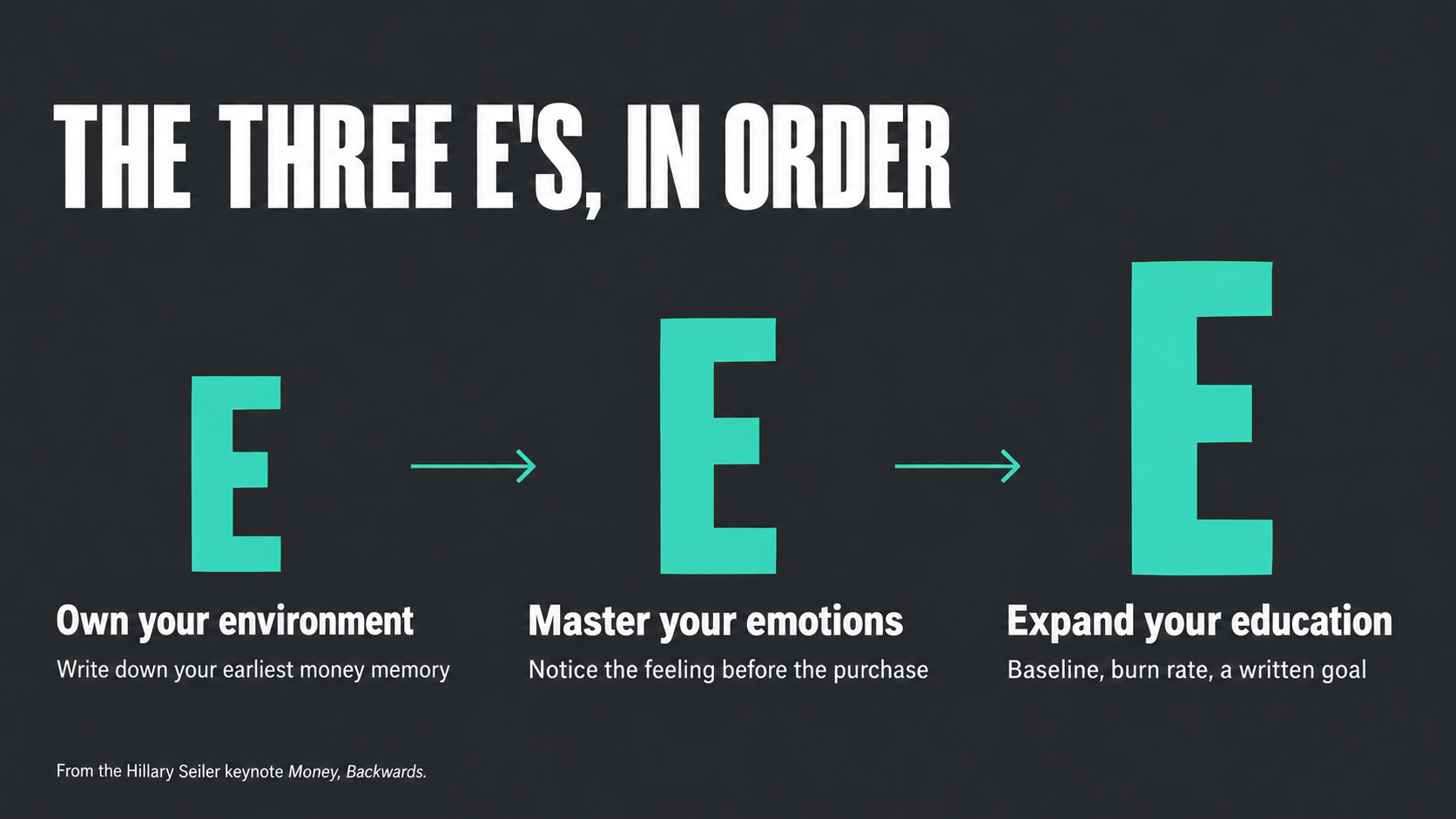
 The psychology of overspending is simple to name and hard to see in yourself. We learn about money backwards. Environment comes first, emotions come second, and education, if it ever shows up, comes last. So the spending pattern is set long before anyone hands us a paycheck. That’s true for a first-year employee and it’s true for the executive running the leadership summit. The fix is the same for both, and it fits in a 60-minute keynote.
I’m not a financial advisor. I’m a coach. I spent 14 years inside banking and mortgage lending, and I’ve spent the last nine teaching money inside NFL and NBA organizations and for employers, associations, and universities. Here’s what those rooms taught me. Smart people don’t struggle with money because they lack information. They struggle because nobody ever showed them where their habits came from. This post walks through the three E’s behind overspending, then shows what changes when a room of leaders works through them together.

What is the psychology of overspending?
The psychology of overspending is the gap between what you know about money and what you learned about money first. Knowledge came from a class, if it came at all. Habits came from home. PwC’s 2026 Employee Financial Wellness Survey found 41 percent of employees say their education or background didn’t adequately prepare them for their finances. It also found 52 percent don’t feel capable of planning for long-term goals. And 59 percent are stressed about money right now. I believe money starts long before the bank account. It starts in the environment we grew up in, and it runs through our emotions before it ever reaches our education. So I teach it in that order, because that’s the order it was learned. Own your environment. Master your emotions. Expand your education. Those three E’s are the whole framework, and a room can work through them in an hour.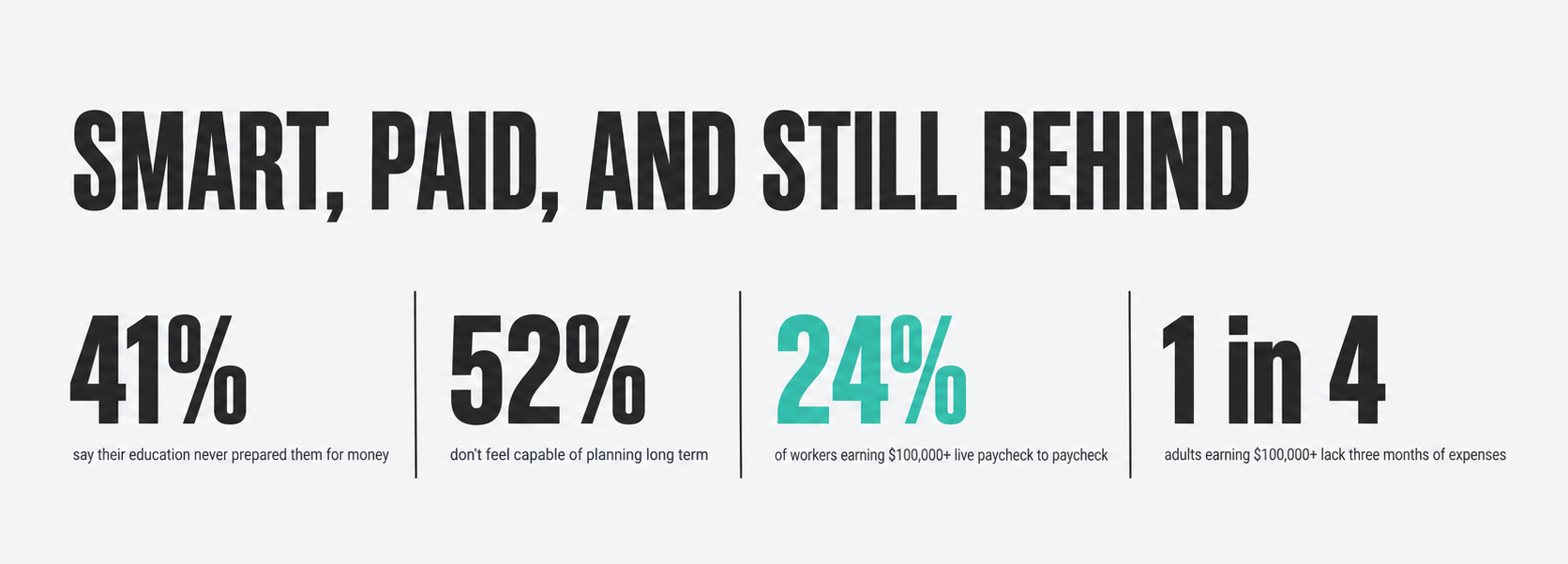
Why do high earners overspend too?
High earners overspend because the pattern moved up with the paycheck. A raise changes the income. It doesn’t change the habits. Bankrate’s living paycheck to paycheck survey found 34 percent of workers say they live paycheck to paycheck, and that included 24 percent of workers earning $100,000 or more. That survey is from 2024, but I see the same thing in every room. The Federal Reserve’s 2025 report on household well-being found 75 percent of adults earning $100,000 or more had three months of expenses set aside. So 1 in 4 high earners did not. That’s burn rate. Take your expenses and divide them by your income. If the lifestyle grows every time the income does, the number never improves. I watched it in mortgage lending for years, and I watched it again in locker rooms with bigger numbers. Executives make the same money mistakes as everyone else, just with more zeros. Then they sit in a leadership session about performance and nobody mentions that their own math has to math first.Environment: where did the spending pattern come from?
The spending pattern came from the first room you learned money in, and most of us have never looked at it. So that’s where I start every session. Pull out a notebook. Write down your earliest money memory. Where were you, who were you with, and what was happening? Then write down your first money lesson, and the first time money triggered a feeling in you. The room goes quiet, and then it laughs, because half the room wrote down a version of the same thing. One person watched a parent hide a purchase. Another heard “we can’t afford that” so often it became a reflex. A third grew up with plenty and was never told where it came from. None of those people chose their environment. But every one of them is still spending from it. Owning your environment means seeing it on paper. That’s the first E.Emotions: why do we spend when we’re stressed?
We spend when we’re stressed because spending feels like control, and losing feels worse than gaining feels good. Kahneman and Tversky showed that in their 1979 paper on prospect theory. People weigh losses more heavily than equal gains. That’s why “last chance” works on a vice president the same way it works on a college sophomore. The fear of missing out is a loss, and the brain moves fast to avoid a loss. Money is a mirror for emotion, so I let the room be uncomfortable for a minute. I ask for a show of hands. Who has felt like they weren’t good enough because of what was in their bank account that month? Every time, the hands go up. That feeling drives more spending than any sale ever did. The Federal Reserve report shows what’s on the other side of it. Among adults who always had money left at the end of the month, 86 percent had three months of expenses saved. Among adults who never did, 13 percent had that cushion. Mastering your emotions means noticing the feeling before the purchase. The room practices that on a real example before we move on. That’s the second E.Education: what actually fixes the psychology of overspending?
Education fixes it, but only when it comes after the first two E’s. That’s the whole point of teaching money backwards. A budgeting tip handed to someone who hasn’t looked at their environment or their emotions lands on nothing. So the education I hand a room is short and it’s built for reps.- Assess your baseline. Know what comes in and what goes out before you change anything.
- Know your burn rate. Expenses divided by income, checked monthly.
- Write the goal down. Big rock goals and small rock goals, reviewed against what you achieved. If you’re not thinking about it, you’re not getting there.